Friday, November 23, 2012

Periods are a lot like presidential elections.

Every American woman knows that when it comes to dealing with menstruation, we have a choice between two very similar candidates, both of which will probably have roughly the same results, cost us the same amount of money, and end up disappointing us in the end. So who’s going to win your vote this year, pads or tampons?

Well, I’d like to introduce you to another option that, unlike Jill Stein, is something that you actually CAN choose! But first, I think it’s essential to take a look at why the first two options are the only ones that we ever hear about.

We already know that we live in a culture of high consumption. And in order to maintain that over a long period of time, it’s essential that people continually have a need to consume. If we only produced durable, reusable goods that lasted a long time, we would have no need to keep buying new goods. For this reason, high consumption absolutely depends upon the disposability of products. This could mean things that are made only for one-time-use, things that are deliberately not built to last, or in the case of the technology industry, constant updating intended to make products obsolete. In the case of personal hygiene products, we’re dealing with the most elementary form of disposability: one-time-use products.

Historically, personal hygiene products were some of the first to be made disposable. The marketing strategy is very clear in this old Kleenex ad: convince people that reusable products are unpleasant and unhygienic. 

The population believes these claims, and the products sell; disposable products shape our material life as they become the norm. The idea that disposability is necessary and hygienic is perpetuated by our use of the products, and eventually that idea starts to be culturally reproduced without corporate influence. Our worldview has now been altered, all by something that started as an attempt to sell a product. (Interestingly enough, this is also how American women started shaving).

So just like no one thinks to use old-fashioned handkerchiefs anymore because tissues are the norm, no one uses cotton cloths anymore either, and we’re left with pads and tampons, which come with a whole host of personal and environmental consequences:

1. They’re expensive!
2. They create an enormous amount of trash:
  - Over 12 billion pads and tampons are used once and disposed of annually. (in addition to all of the wrappers and packaging that go along with them).
  - according to the Center for Marine Conservation, over 170,000 tampon applicators were collected along U.S. coastal areas between 1998 and 1999.
3. Although they are made with chemicals including chlorine bleach (which inevitably makes it into lakes and rivers), the FDA does not require the contents to be disclosed. Also, no pads or tampons have been sterilized.
4. I'm sure I don't have to tell you how inconvenient it is to be tied down to a purse full of tampons and a bathroom with a trash can for an entire week.
5. Ever tried to go camping or hiking while on your period? Good luck taking care of tampons without the luxury of indoor bathrooms.

Of course this is certainly not a comprehensive list of grievances; I'm sure one could spend days trying to write one of those up. But with all of the flaws of pads and tampons in mind, the question is, what else can we do? The answer is that there are other options which are more simple, convenient, healthy, and less environmentally destructive: menstrual cups and reusable cotton pads.

First, let's talk about menstrual cups. It's exactly what it sounds like: a soft cup that is used internally and collects fluid. My preferred brand is the Keeper, for a few reasons: they are more environmentally in the manufacturing process than other cups, they use fair labor practices (to the best of my knowledge), and they are generally less wrapped up in advertising and corporate flair. I find the cup significantly more convenient than tampons because it needs to be changed (washed out) less frequently, it leaks less, and you never have to worry about dragging supplies with you everywhere you go. Based on numerous conversations with other women about menstrual cups, here are some questions I have often been asked:
- How does it stay clean/ isn't that dirtier than using tampons?
It washes completely clean with soap and water. Tampons, on the other hand, contain chemicals like bleach, are not sterilized, and can leave fibers in your body.
- Can't it fall out?
No. Your muscles naturally keep it in place.
- What if it overflows?
It won't overflow. The capacity is about what a normal woman's flow is over an entire period.
- Is it hard to use?
It takes a little bit of getting used to, but once you're familiar with it it's very easy to use.
- Can you feel it?
Nope! You can't feel it any more than a tampon when it's in the right way. It does appear to be bigger than it feels, but it's shaped to fit your body.

Here is a complete explanation on how to use it, and other parts of the site have more information and the option to order one online.

And here's a little bit of propaganda:

If the cup isn't your thing, or if backup protection is, then another option is reusable cotton pads and pantiliners. Pretty much every kind that they sell in disposable form is also made in reusable form, from liners to thicker ones and special heavy or overnight sizes. They can be found at most health food stores, but the problem with these is that I find them to be a bit expensive (although still much cheaper than buying disposable in the long run). You can buy these in a store or online (one brand name is Glad Rags), or if you don't want to spend the money you can easily sew some up yourself, or just use regular cotton rags and fold them around your underwear to keep them in place.

They're easily kept clean by, naturally, washing them. A helpful tip is to soak them in some water and hydrogen peroxide in between wearing and putting them in the washing machine; this both disinfects and bleaches out stains.

In conclusion, the routine that I find most convenient and effective is using a cup along with light cotton liners. Switching to this from disposable products has made my life a great deal easier, not to mention the huge amount of waste eliminated. Although the culture that we live in demands that we throw things away constantly for the sake of "hygiene" (read: profit), it is in the best interests of your body, your planet, and your humanity to NOT support a system which does not support you.

Saturday, November 17, 2012

The Ironies of Black Friday (TL;DR: read the list at the bottom).

Call me romantic, but I find it rather unfortunate that the holiday season (which apparently now starts around the first week of November) is the time when capitalist consumer culture is the most obvious. Christmas decorations in the form of business promotions have been going up well before Thanksgiving for several years now (although it seems to get earlier every year), and many Americans have simply embraced the fact that the holidays are more about buying shit than about the "Christmas Spirit" which may or may not have existed at one point–

But aside from the cliché lament for the nostalgic days of yore when people allegedly cared about goodness and generosity for a week or two during December, there is cause for serious concern regarding how we consume during this season. These next few weeks are by far the most profitable time of the year for retail corporations due to the overwhelming need that we feel to consume in order to please ourselves and others. And as this ideology becomes embedded deeper within our culture every year, it only furthers the ideals of high consumption that we participate in year-round. With each holiday season, we are entrenching ourselves further into the logic of capitalism, and thereby worsening all of the ills that it facilitates: class division, the widening income gap, environmental destruction, sexism, racism, poverty, the power of corporations to control our politics... oh, and waste.

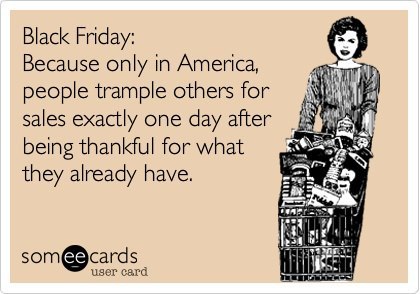
And of all the crazed overconsumption that goes on during the holiday season, a huge amount of it is concentrated into the 20 soulless hours that are appropriately dubbed Black Friday. As if we live within some anti-capitalist apocalyptic sci-fi novel, it has literally gotten to the point where people trample others to death for the opportunity to consume. Just as Americans seem to have resigned themselves to the fact that Christmas is centered around buying shit, they also seem to readily recognize the morbid irony and illogic nature of Black Friday, as exemplified in one of many someecards of this approximate nature:
But this begs the question: why are we so ready to recognize the faults of this system and even laugh at how ridiculous it is, only to continue to participate in it without a second thought? With the rise of internet memes, we have become incredibly skilled at criticizing the hypocrisies and wrongs that surround us, laughing at them, and then accepting them anyway.

So if you are in the majority of Americans that agrees that the holiday season is centered around consumption, but the minority that wishes not to participate in it, this list will be your friend:


As per my nature, #1 is my favorite. In the past few decades, we have stopped using our material creativity and resourcefulness due to our dependence on buying new things, so many people might doubt their ability to make a gift. But never fear! There are easy things that everyone can make. For example, make an easy notebook and fill it with recipes, or bake the simplest loaf of bread ever. A quick perusing of a website like eHow should turn up endless possibilities.

Another idea is to outsource your homemade gifts to people you know. For example, have your aunt who knits amazing hats make one for your girlfriend, and barter with or (sigh, if you must) pay your aunt for it.

And since you'll be free on Black Friday, please consider attending a solidarity action to give critical support to workers who are underpaid and mistreated as a result of the system which holiday consumption contributes to. This website allows you to search for wal-mart strikes and actions taking place near you.

Thursday, September 13, 2012

Leftovers + Flour = Bread

"Turning leftovers into the staff of life."

Earlier this summer, I bought an old copy of the Tassajara Bread book on a friend's recommendation. I read through it for the first time the other day, and was particularly excited about one recipe that I found (and even more excited after it yielded delicious bread). The key ingredient is leftovers, and it's actually better if they have started to go sour since the bread has no yeast, and the slight fermentation will give the bread extra rise. Pretty much any leftovers- cooked grains (rice, oatmeal, quinoa, wheat, etc.), vegetables, soups, any just about anything else will work. It's incredibly easy to make, delicious, cheap, and makes use of precious leftovers that would otherwise need to be thrown out.

A quick note: using sour leftovers in this recipe is perfectly safe and is not a potential source of sickness or food poisoning. The bacteria that makes food sour is rarely harmful in the first place, and baking the bread will kill all of the bacteria that might be present anyway.

The recipe is as follows:

GRUEL BREAD
(per loaf)

4 cups rice gruel (cooked-together leftover rice, or other grain, soups, vegetables, salad)
6 cups whole wheat flour (amount will vary depending on how moist the gruel is)
1 teaspoon salt or soy sauce
1/4 cup oil (optional)

Add salt and oil to gruel. Add flour to gruel, first by stirring, then with hands, until a dough of kneadable consistency is formed. Mixture should be of "earlobe" texture, firm yet pliable. Leave slightly moist, as more flour is added while dough is kneaded on floured board until smooth (about 300 times). Make into loaf. Place in oiled bread pan. Brush top with water. Make a 1/2" deep cut down the center of the loaf. cover with damp towel, and set in warm place overnight. Bake at 350-375° for 75-90 minutes, until sides and bottom are dark brown.

NOTES:

This recipe is highly adaptable. I adjusted the amounts for 3 cups of gruel, since that is what I had on hand, and it made a loaf of decent size. If the gruel does not have a good amount of liquid in it, you will need to add small amounts of milk or water until there is enough for the amount of flour you have added. The salt or soy sauce is not necessary, especially if the leftovers already contain some sodium. When kneading bread, keep board and hands floured until the dough becomes stretchier and no longer sticks to hands or board. This is how you know when it has been kneaded enough (300 times seems to work perfectly). To bake bread, almost any oven-safe container can be used- rectangular bread pans, a round ceramic casserole dish for a round loaf, even a flat pizza stone would probably work well. The bread need not be set out to rise overnight; as long as it has 8-ish hours it is fine (bread doesn't know what time of day it is). I have not tried this recipe with any kind of flour other than wheat, but I'm sure that it would work just fine with any other flour as a gluten-free option. 

A great option for flour is "white whole wheat"; it is just as nutritional as ordinary whole wheat flour but is made from a more mild variety of wheat that is less strong tasting. It can be used for ANY baking, including cakes, desserts, and pastries, just like all-purpose flour.

Wednesday, April 18, 2012

Homegrown Notebooks

As promised in my previous posts, here is a simple tutorial for making lined (or not) notebooks from (mostly) recycled materials. My biggest problem with notebooks has always been that I either run out of space or only use half of the pages, so I end up with notebooks full of notes from 3 different classes, or the notes for one class at the backs of 3 different old notebooks– but these solve the problem. I made a few of these for myself at the beginning of the semester, and I love them because I can take out, add, and rearrange the order of the pages. And when the whole thing is filled up, I can take out all of the paper and put fresh pages in for a whole new notebook.

Here's what you need:

1. USED Standard 8.5 x 11 paper that's blank on one side– about 30 to 60 sheets per notebook (see my last post for info on where to get this paper to reuse)
2. Some USED cardboard or heavy paperboard (use corrugated cardboard from cardboard boxes for a heavier cover, or cereal boxes for a lighter cover.)
3. Duct tape
4. 1-inch metal binder rings– 3 per notebook (these are cheap if you buy them in bulk. I got mine here) If you don't want to buy new materials, you could also use string, zipties, or anything else your heart desires. But the binder rings work best.
5. A single hole punch (triple hole punches won't work well)
6. A ruler and a pencil
7. A computer and a printer (if you want lined pages)
8. Binder/ butterfly clips are helpful, if you have them.

Here's what you do with it:

1. PRINT THE LINES. If you want your notebook to have lined pages, print them onto the blank side of your sheets of paper. I did this by creating a simple Word document in landscape orientation and using _underscores_ to make lines all the way across the page. You can adjust the spacing for a bigger or smaller rule, whatever suits your fancy. For a standard rule, set it to size 12 font with 1.3 line spacing. And the lines can be whatever color(s) you want! I made my pages in 6 different colors. Make sure that (1) the paper is loaded into the printer so that it will print on the blank side and (2) the color of your lines is dark enough to show up on the paper (in other words, yellow is a no-go).

2. PUNCH HOLES IN THE PAGES. Fold the sheets of paper in half the hamburger way (I really don't know how else to describe it) with the blank/ lined side facing out. Align them in a stack with the folds facing in the same direction: vertically and to your right- this will be the orientation of your notebook. It might help to hold the stack together with binder/butterfly clips. Place the ruler along the left side of the pages (the opposite side of the fold) and make a thick mark down the side of the stack (the "spine" of your notebook) at the midpoint, or 4.25 inches. Make two more marks like this 1 inch in from the top and 1 inch in from the bottom of the pages. Working in groups of about 5 pages at a time, punch a hole along the left edge at each of these marks, about 1/3 inch in from the side. You'll end up with all of the pages 3-hole punched, like binder paper.


The duct tape spine
3. MAKE THE COVER. Cut your cardboard or paperboard into two rectangles the same size as or slightly bigger than your pages. Using a hole-punched page as a guide, make 3 marks on the covers and punch 3 holes to line up with the pages. Listen closely, this part can get tricky: Rip 2 strips of duct tape that are the same length as the tall side of the cardboard covers, and 2 more strips that are a few inches longer than the first 2. Lay one of the long strips down sticky-side up, and place a short strip sticky-side down on top it with the centers aligned. This should create one long, non-sticky strip with sticky "tabs" left over on the top AND the bottom. Fold these tabs over to make one non-sticky strip the same length as your covers. Now, take the second long strip and lay it down sticky-side up like the first one. Take the strip you just made (folded-over tabs facing up) and overlap it with the sticky strip ONLY by about 3/4 inch, again with the centers aligned so that the longer strip has excess on the top and the bottom. Lay the last short strip over the middle of the long strip, lining the top and bottom edge up with the other short strip and leaving only two sticky tabs on the top and bottom. Fold these tabs over. You should now have one wide, non-sticky spine for your notebook. Phew.


4. PUT IT ALL TOGETHER. Hold the pages together with a binder/butterfly clip or two so that the holes all line up. Put the front and back cover on the- you guessed it- front and back. Your duct tape strip should have a 3/4 inch wide thicker part in the middle from where all of the pieces overlap– this is the outside of your notebook's spine (what would be visible if it was stacked on a bookshelf). Place the spine against the left side of the notebook, with the side that has the folded-over tabs facing in towards the pages. The spine will bend on either side of the thick middle, with the two other sides resting flat against the front and back covers (make sure the covers are pressed all the way up to the bend). Rip two strips of duct tape about 4 inches longer than the length of the notebook. Holding the spine flat against the front cover, overlap the duct tape with the spine by about 1/2 inch and press it against the cover, folding the excess on the top and the bottom over the cover and sticking it to the inside of the cover. Repeat for the back cover. Now use a pen or other sharp object to poke a hole through the duct tape to re-open the holes punched in the covers. Thread your binder rings (or string, or zip ties) from the outside through the holes in the covers and in the pages, and clip them closed on the inside.


5. Take notes! It also functions as a binder: you can punch holes in any papers (handouts for a class, etc.) and add them to the notebook.

If you make a notebook, please leave a comment letting me know how it worked out!

Thursday, April 12, 2012

Paper, Paper Everywhere!

Printed side of salvaged paper

the beautifully blank flipsides
Paper is ubiquitous, and it's central to our daily lives as well as to the issue of environmental sustainability. This is especially true if you're a student- we're constantly surrounded by event fliers, handouts, and term papers (yes, hard copies do still exist). Coincidentally, paper is also something that we use up all the time. Here's a relatively simple idea: if there's an abundance of a resource around us, why not use that supply instead of throwing it out and buying new paper?

Many of you are probably thinking, "duh, that's called recycling." But there's a huge gap that we're missing here: reusing. Paper that's only been printed on one side has only been half used, so we can cut out the middle man (and our paper budget) and just use the other side instead of throwing it in the recycling bin, using energy to process it, and then buying a package of recycled printer paper.

And now you're thinking, "duh, double-sided printing"- but I'm proposing something a little more resourceful. Lots of things are printed on only one side, mostly fliers that are hanging everywhere around workplaces, coffeeshops, and schools. By collecting these materials, you can gather a stockpile of perfectly good paper for all of your printing and writing needs, saving resources and money at the same time!

My tactics for collecting paper:
1. The best source for me is fliers for events that have gone by. Dates on fliers are usually big, so these are easy to spot. Look on bulletin boards (or anywhere if you're a student, they're all over campuses).
2. Look in recycling bins- especially the ones next to a printer or copier. These are almost always full of barely-printed on, virtually new printer paper.
3. If you're a student or work in an office, chances are you frequently turn in printed reports and the like. Reuse these sheets if you get them back (carefully take out staples and they're good as new).

Uses for your reused paper:
1. Print anything you would print on new paper on the blank sides. (I like this better than just double-sided printing because lots of things I need to print are only one page).
2. Use it as scrap paper, instead of small note pads and sticky notes.
3. MAKE YOUR OWN LINED NOTEBOOKS! (I'll be posting the instructions for making these next.)

This might seem a simple and obvious suggestion, but here's my rationale for sharing it: I have yet to see anyone else do this. This was precisely my reason for starting this blog: the solution to a happy life that treads lightly on the Earth lies in simplicity. The answers are in plain sight, and I want to share the ones that I have found.

Thursday, April 5, 2012

A Good Name is Hard to Find

A few months ago, I decided that I wanted to start a blog. Not a rare decision to make nowadays, as it seems just about everyone on the internet has started a blog at one time or another (whether that is for better or worse, I will hold judgement on for now). Having the same impulsive and enthusiastic response as I do to most of my own "creative" ideas, I immediately went to wordpress.com, clicked on the "Get Started" tab, and put my cursor in the first dialog box: blog address...

...And that's where I've been for the past few months. I couldn't come up with any blog titles that sounded good enough off the top of my head, so I started scratching ideas down in a notebook, asking friends' advice, writing haikus in hopes that a single line would stand out as a decent title. Nothing good came of this for a while, and when I did actually start thinking up some possible titles, there were already 3 different blogs by the same name and I couldn't get the subdomain I wanted. 

Finally, I've thought of a name that works, and I will put off commencing this blog no longer! I chose "Bathtub Gin" because it's very similar to the kinds of things I will be writing about- that is, subversive and homemade. This blog will be dedicated to making people's lives simpler, happier, and more environmentally sustainable. I'll write about making the things we need from what we already have, finding ways to simplify everyday tasks, and connecting our lives back to the soil under us and the people around us. Think of complacent consumer culture as Prohibition, and I'm the bootlegger bringing you the goods.

Thanks for reading my inaugural blog post, and I look forward to the adventure ahead. Feel free to comment or email me with any requests or suggestions! 
-Moira

(p.s.- Coming very soon will be a tutorial on making great notebooks from reused materials that I know everyone has lying around. It'll be great fun.)